
Key Takeaways
- To elect S corporation status, first register an LLC at the state level, then file Form 2553 with the IRS
- S corp status can reduce your tax bill, but it comes with extra expenses (financial admin, tax filing)
- S corp savings only outweigh extra expenses when your gross income is $100,000 or more
One of the most important decisions you’ll make in your journey as a therapist and private practice owner is what your business entity will be—a “sole proprietor” or an “S Corporation." The difference between these two entities comes mainly from how you’ll be taxed.
{{ resource }}
What's a sole proprietor?
When you’re a sole proprietor, you are the one in control of your private practice. You own it and you personally pay its taxes. For tax purposes, your person and your business are identical.
You’ll report any profits on your own personal tax return at the end of the tax year. Learn more about tax basics for sole proprietor therapists.
What's an S corporation?
An S corporation is a tax designation granted by the IRS. To keep things simple, this legally separates your company from you as an individual.
S corporations, like sole proprietors, are pass-through entities. Your practice income passes through you as the owner of your S corporation. You don’t have to pay separate taxes on your business.
Contrast that with a C corporation, which is taxed as a separate entity.
Income in the form of distributions (similar to dividends) passed through to an owner from an S corporation is not subject to self-employment tax. The owner only pays income tax on their salary. Learn more about tax basics for S corporation therapists.
Tax benefits for S Corporations
Being taxed as an S corporation can provide a variety of other benefits:
One number to hold alongside the tax savings: sole proprietor therapists kept a 72.1% net margin in 2025, compared with 64.4% for S corp practices, according to Heard's 2025 income report, a gap that reflects the payroll and overhead S corps typically carry.
- Limited liability. Before electing S corp status, you must register your business as a limited liability company (LLC) at the state level. That limits your personal liability for business debts.
- Ownership transfer and sharing. You can assign full or partial ownership of your S corp to other individuals. It’s easier to sell your business or bring on partners when it’s an S corp.
- The qualified business income (QBI) deduction. The QBI deduction lets you write off up to 20% of your practice’s income, significantly lowering your tax bill. As a pass-through entity, an S corp qualifies for this deduction.
- Self-employment tax savings. As an owner-employee, only your salary is subject to the 15.3% self-employment tax. Income you receive in the form of distributions as a shareholder are not subject to self-employment tax.
Paying yourself a reasonable salary
In theory, the owner-employee of an S corporation could pay themself a very, very small salary, and collect the rest of their pay in the form of distributions. Since only their salary is subject to self-employment tax, they would substantially reduce their tax burden.
The IRS realizes this, and they don’t want S corp owners dodging self-employment tax. That’s why they require you to pay yourself a reasonable salary.
A reasonable salary is about on par with what similar professionals in your industry—with similar levels of experience and training—earn.
If the salary you pay yourself is less than what the IRS considers reasonable, they can retroactively charge you additional self-employment tax on your earnings.
For more, check out How to Calculate a Reasonable Salary as an S Corp Therapist.
{{ consult }}
How to convert from a sole proprietor to an S corp
To become an S corp, you first need to register your practice as an LLC in the state where you practice.
At the state level, you’ll be treated as an LLC. At the federal level—after electing S corp status, a separate step—you’ll be treated as an S corporation.
Heads up: Running an S corporation comes with extra financial admin and higher accounting fees. Those extra costs are only outweighed by the potential tax savings from an S corp if your gross profit is about $100,000 or more. For a deeper dive, check out When Should My Therapy Practice Become an S Corp? and the S Corp Tax Savings Calculator for Therapists.
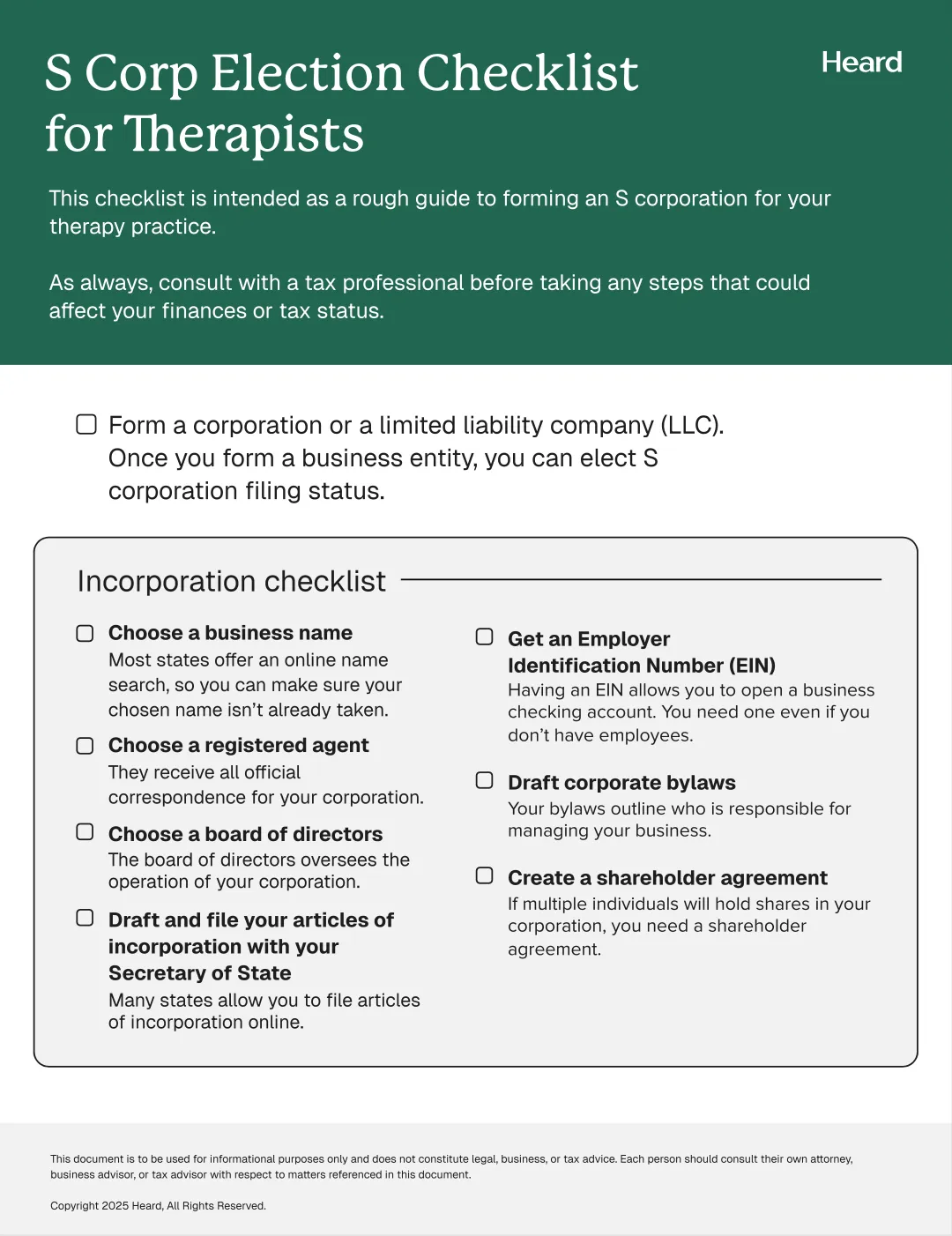
- Apply for an Employer Identification Number (EIN) from the IRS
Registering an EIN is free and only takes a few minutes.
You’ll need an EIN to open a business bank account and register your practice as an LLC.
- Form a business entity
Before you can elect to be taxed as an S corporation by the IRS, you first need to form a business entity with your state. Most therapists form an LLC.
Because you’re a therapist, some states require you to form a professional services LLC (PLLC). For instance, California and New York State both require mental health professionals to form PLLCs.
Depending on your state, that may significantly increase the amount of time it takes to become an S corp. Check your Secretary of State’s website for details on forming a PLLC, or learn more from one of our state-specific guides.
You can also learn more from Difference Between LLCs and PLLCs For Therapists.
- Fill out and file IRS Form 2553
File Form 2553 to elect S corp status with the IRS.
To elect S corp status for the current year, file Form 2553 within two months and 15 days of the beginning of the year.
After that deadline, you can file Form 2553 any time to elect S corp status for the following year.
What happens if you miss the S corp election deadline?
If you miss the deadline but would really like to elect S corp status for the present year, you may file a late S corp election.
To do so, file Form 2553 as you normally would, but with a few additional notes:
- On Line I, Part I of Form 2553, enter your reason for filing late: “The information necessary to make an informed decision about the entity’s status was not available in time to file a timely election.”
- At the top of Form 2553, write “FILED PURSUANT TO REV. PROC. 2013-30.”
- If you are also filing Form 1120-S, write INCLUDES LATE ELECTION(S) FILED PURSUANT TO REV. PROC. 2013-30 across the top.
These notes reference Revenue Procedure 2013-30, which includes the rules by which a company can file late for S corp status.
—
For a comprehensive overview of S corp structure for therapists—plus how to decide whether an S corp is right for you—check out The Complete S Corp Guide for Private Practice Therapists.
Summary
- By default, the IRS treats your business as being identical with your person (a sole proprietor)
- Registering an LLC or PLLC and electing S corp status makes your business a separate business entity
- S corp status decreases personal liability and offers opportunities for tax savings
- You only owe income tax on the salary your S corp pays you, not on additional income you receive in the form of distributions
- To elect S corp status for the current year, file Form 2553 no later than two months and 15 days after the state of the year
This post is to be used for informational purposes only and does not constitute legal, business, or tax advice. Each person should consult their own attorney, business advisor, or tax advisor with respect to matters referenced in this post.
Bryce Warnes is a West Coast writer specializing in small business finances.
{{ cta }}
Manage your bookkeeping, taxes, and payroll—all in one place.

Discover more. Get our newsletter.
Get free articles, guides, and tools developed by our experts to help you understand and manage your private practice finances.
We’ll tell you when it’s the right time and even file the paperwork for you. Schedule a free consult to learn more.
Schedule a free consult