
An S corp may make sense for your physical therapy practice once your annual profit reaches roughly $80,000 to $100,000, depending on your state, your costs and the salary you'd need to pay yourself. For many full-time PTs, that salary is high, so the savings often show up closer to the top of that range or above it.
This guide walks through how an S corp works for a PT private practice, how to think about a reasonable salary, what changes for cash-pay, insurance and Medicare practices, and how to time your election.
What an S corp is, in one minute
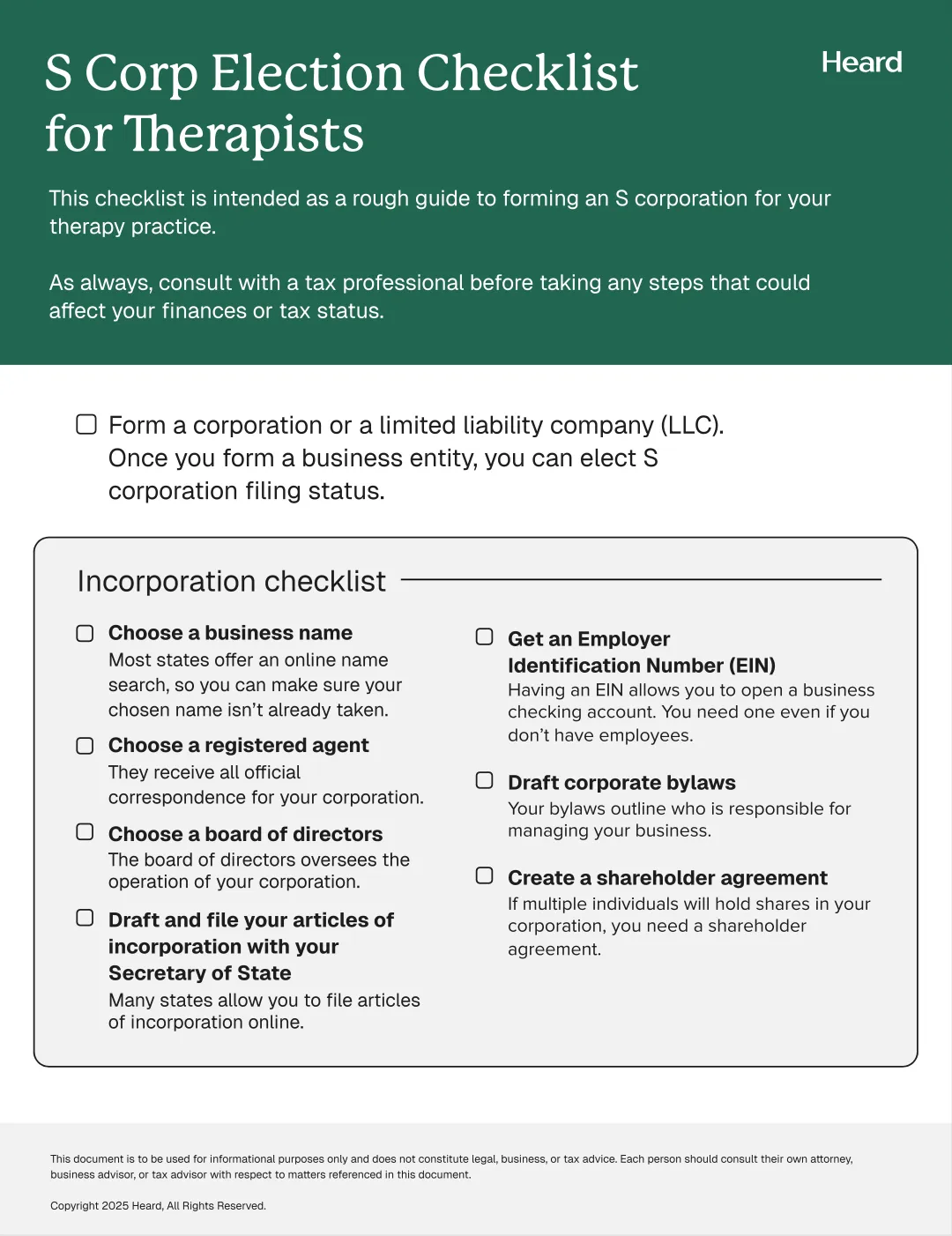
An S corp is a tax status, not a separate business type. Your practice first forms an LLC, PLLC or professional corporation with your state. Then it elects S corp status with the IRS by filing IRS Form 2553.
Once you're an S corp, you pay yourself two ways:
- A salary through payroll, with Social Security and Medicare taxes withheld and matched by the practice.
- Distributions from the remaining profit, which aren't subject to those payroll taxes.
As a sole proprietor, you pay self-employment tax (15.3% on most of your net earnings, up to the Social Security wage base) on nearly all of your profit. As an S corp, payroll taxes apply only to your salary. That gap is where the potential savings come from.
For the full mechanics, see The Complete Guide to S Corporations for Therapists. The rules are the same for PTs.
When does an S corp make sense for a PT practice?
Heard's general range is roughly $80,000 to $100,000 in annual profit. That's profit after expenses like rent, equipment, software, insurance and staff, not your gross collections.
For PTs, the deciding number is often the gap between your profit and a reasonable salary for your work. The bigger that gap, the more profit can come out as distributions, and the more an S corp may save.
Some signs you may be ready:
- Your practice has been open at least a full year, so you can project profit with some confidence.
- Your profit is steady or growing, not swinging month to month with denials or slow payers.
- Your profit sits well above what you'd pay a PT doing your job.
- You can cover the added costs: payroll, a business tax return and any state fees.
A rough example
Here's how the payroll tax math can look in three situations. These are simplified federal estimates only. They leave out income tax differences, the deduction for half of self-employment tax, the QBI deduction, state taxes and the costs of running an S corp.
| Situation | Annual profit | Owner salary | Self-employment tax as a sole prop | Payroll tax on salary as an S corp | Rough difference |
|---|---|---|---|---|---|
| Full-time clinical PT, strong profit | $150,000 | $100,000 | About $21,200 | About $15,300 | About $5,900 |
| Full-time clinical PT, thinner profit | $110,000 | $100,000 | About $15,500 | About $15,300 | About $200 |
| Part-time clinical hours, lower salary supported | $110,000 | $65,000 | About $15,500 | About $9,900 | About $5,600 |
Illustrative only. Self-employment tax estimated as 15.3% of 92.35% of profit; S corp payroll tax as 15.3% of salary (employer and employee halves combined). Your numbers will differ.
The middle row is the one to notice. When your profit is close to a reasonable PT salary, an S corp may save little or nothing once you add its costs. To see your own estimate, try Heard's S corp calculator.
{{consult}}
How to set a reasonable salary as a PT
The IRS requires S corp owners who work in the business to pay themselves reasonable compensation before taking distributions. There's no single formula. The IRS points to factors courts have used, including your training and experience, your duties, the time you put in, and what comparable businesses pay for similar work.
For PTs, public wage data is a useful starting point. The U.S. Bureau of Labor Statistics reports a median annual wage of $102,760 for physical therapists in May 2025, with the lowest 10% earning under $77,140 and the top 10% over $135,140. Those figures are for employed PTs, not practice owners, so treat them as context and one input, not your answer.
Other inputs that may move your number:
- Your hours. A PT treating patients 20 hours a week may support a lower salary than one treating 40.
- Your local market. PT pay varies a lot by state and metro area.
- Your specialty. Orthopedic, pelvic health, pediatrics and sports specialties can command different pay.
- Your management work. Running a clinic, supervising staff and handling billing are part of your job, too.
Write down how you set your salary and why. If the IRS ever asks, notes and comparable wage data help. For more on the method, see How to Calculate a Reasonable Salary.
Cash-pay vs insurance and Medicare practices
How you get paid can change how an S corp feels day to day.
Cash-pay practices are paid at the time of service, so cash flow tends to be more predictable. That makes it easier to run a steady payroll and to project profit before you elect.
Insurance and Medicare practices often wait weeks for reimbursement and deal with denials and rate changes. Your salary has to be paid on schedule even when claims are slow, so keep a cash cushion. It also helps to base your profit projection on what you've collected, not what you've billed.
Does an S corp election affect Medicare enrollment?
The S corp election itself is a federal tax status. It generally doesn't change your NPI, and if your LLC or corporation is already enrolled, electing S corp status usually doesn't change its EIN.
Forming a new entity is different. Moving from a sole proprietorship to a new LLC or professional corporation usually means a new EIN and legal business name, which can require updating your Medicare enrollment and your other payer contracts. According to the American Physical Therapy Association, PTs in private practice enroll on the CMS-855I, practice entities enroll on the CMS-855B, and most changes must be reported to your Medicare Administrative Contractor within 90 days, with ownership and practice location changes due within 30 days. Confirm the steps with your MAC before you switch, so claims don't stall.
Do PTs need a professional corporation or PLLC?
It depends on your state. Many states require licensed professionals to use a professional entity, and a few limit which entities PTs can use. Two examples:
- California generally requires PTs who incorporate to form a physical therapy corporation under the Moscone-Knox Professional Corporation Act, and regular LLCs generally can't provide PT services there. California S corps also pay a state tax of 1.5% of net income, with an $800 minimum, according to the California Franchise Tax Board.
- New York lets PTs practice through a professional service corporation (PC) or professional service LLC (PLLC), among other structures, not a general business corporation.
A PLLC or professional corporation can elect S corp status the same way an LLC can, by filing Form 2553. Check your state PT board and Secretary of State before you form, since rules change. Our guide to starting a physical therapy private practice covers entity setup step by step.
Group PT practices with PTAs and aides on payroll
If you already employ PTs, PTAs or aides on W-2 payroll, much of the S corp setup is in place. Adding yourself to payroll is one more employee, not a new system.
Group practices also shift the salary question. The IRS notes that profit generated by non-owner employees, capital or equipment can properly be paid as distributions. Profit from your own clinical and management work is what your salary needs to cover. So an owner whose clinic runs on a team of clinicians may have a larger share of profit that can come out as distributions than a solo PT treating every patient.
Group practices also bring more payroll filings, benefits decisions and, if you have co-owners, shareholder rules. S corps can have only one class of stock, so profit splits between owners need care.
{{consult}}
Equipment purchases and depreciation
PT practices buy a lot of equipment: treatment tables, modalities, exercise equipment, and sometimes larger items like a treadmill or a build-out of a clinic space. How you deduct those purchases can affect your S corp math.
- Big deductions lower profit for that year. Expensing equipment through Section 179 or bonus depreciation may reduce your practice's profit, which reduces the distributions left after your salary in that year.
- Your salary doesn't drop with it. A reasonable salary is based on your work, not on your equipment spending.
- Section 179 has limits tied to business income, while bonus depreciation works differently. Recent federal law changes expanded both, so ask a tax expert which fits a given purchase.
- Timing matters. A heavy equipment year can be a quieter S corp savings year. Plan big purchases alongside your election.
For the full list of what PTs can write off, see The Complete List of Tax Deductions for Physical Therapists.
Other things to weigh
- Added costs. Payroll service, a separate business tax return (Form 1120-S), and state fees or franchise taxes in some states.
- QBI. Your S corp salary isn't counted as qualified business income, so a higher salary may shrink that deduction. The QBI rules also have income limits, so this is worth modeling.
- Retirement savings. Some retirement plan contributions are based on your salary, not distributions, so a lower salary may limit how much you can put away.
- More upkeep. Keep business and personal money fully separate, run payroll on time, and file on time to keep your liability protection and your S corp status.
When to elect: the January 1 window
Most PT practices use the calendar year. To be taxed as an S corp starting January 1, 2027, you can file Form 2553 any time during 2026 or by March 15, 2027, which is two months and 15 days after the start of the tax year, per the Form 2553 instructions.
Electing at the start of the year keeps your books clean: one tax status for the whole year and payroll from the first paycheck. If you miss the deadline, relief may be available. See what happens if you miss the S corp election deadline.
Prefer video?
This S corp basics walkthrough was made for therapists, and the mechanics are the same for PTs.
How Heard's S corp calculator works
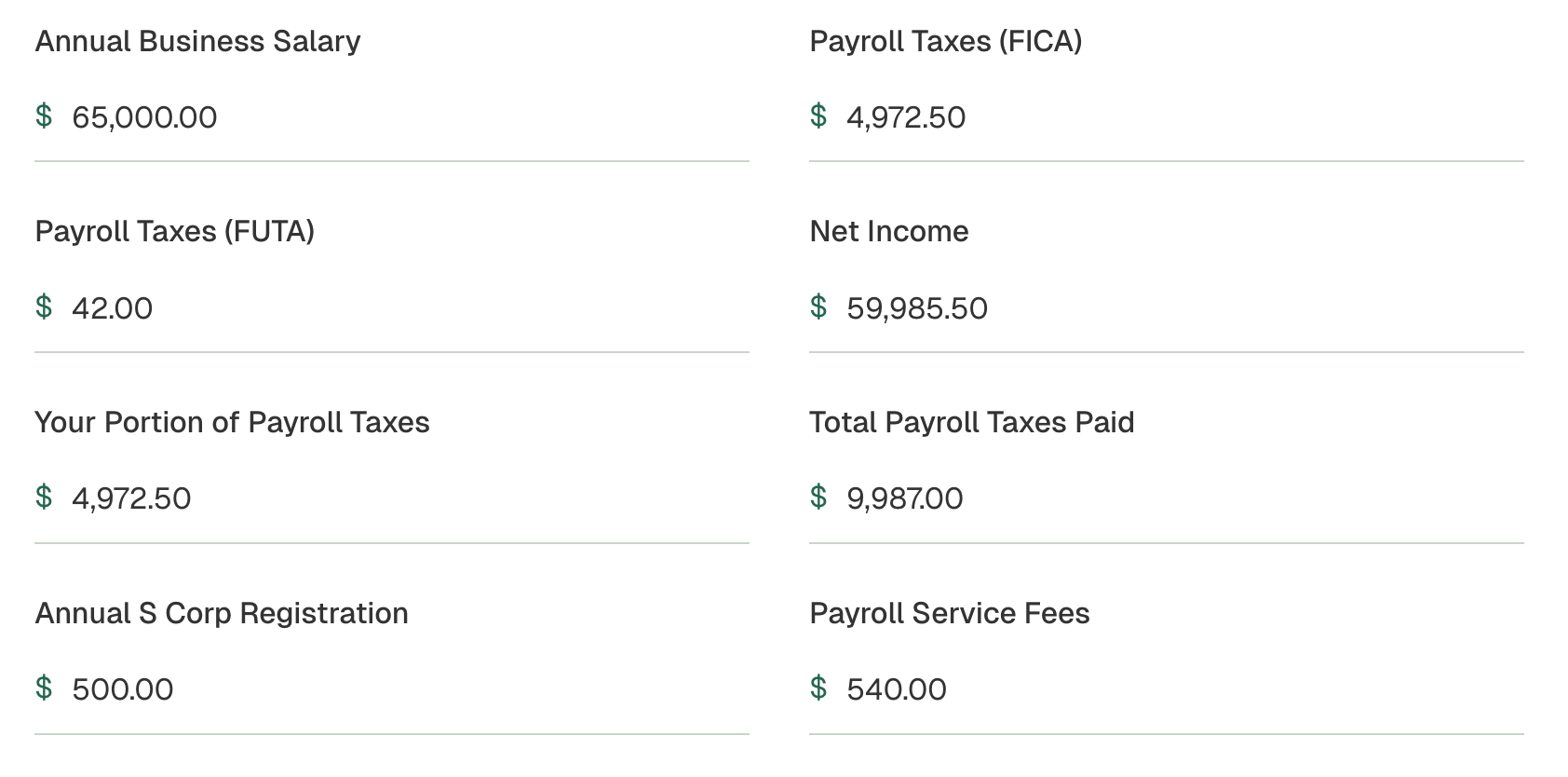
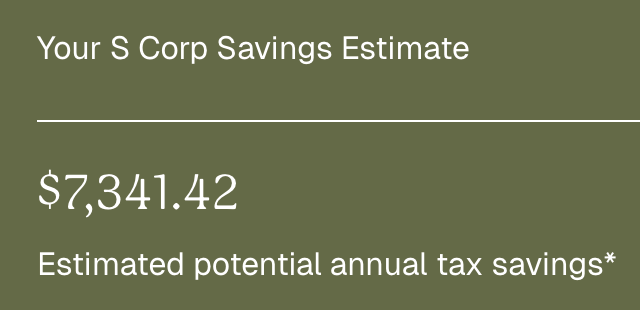
Heard's S corp calculator gives you a ballpark of what you might save by electing. It's an estimate, not an exact calculation, and some fields like salary are filled in for you.
- Enter your annual revenue and expenses

- Click "Calculate Estimated Savings"
The calculator suggests a salary and works out payroll taxes and net income from it, including estimated fees for S corp registration and payroll.
- Review your estimated savings
Savings compare filing as an S corp with filing as a sole proprietor. For PTs, check the suggested salary against your own hours and local PT pay, then talk it through with an expert.
How Heard helps PTs with S corps
Heard is financial management software built for private practice, now including physical therapists. For PTs weighing an S corp, Heard can:
- Run a free S corp assessment on your numbers and give you an honest answer either way.
- File your S corp election with the IRS.
- Set up and run your owner payroll so your salary and payroll taxes go out on time.
- Help you set a reasonable salary based on your work and your numbers.
- Keep you compliant with bookkeeping, quarterly planning and your business and personal tax returns.
Heard doesn't handle patient billing, insurance claims or Medicare enrollment. Your billing team or software keeps doing that. See pricing for what each plan includes.
Not sure if the timing is right? Book a free consult and a Heard expert will look at your numbers with you.
Frequently asked questions
At what profit should a physical therapist consider an S corp?
Heard's general range is roughly $80,000 to $100,000 in annual profit, depending on your state and costs. Because a reasonable salary for a full-time PT is often high, many PT practices see meaningful savings only when profit is well above that salary.
How do I calculate a reasonable salary as a PT practice owner?
Look at what a PT doing your work would earn, adjusted for your hours, location, specialty and management duties. BLS reports a median wage of $102,760 for employed physical therapists in May 2025, which is one useful input. Document how you chose your number.
As an S corp physical therapist, do I need to run payroll?
Yes. If you work in your practice, the IRS expects you to pay yourself a reasonable salary through payroll, with taxes withheld, before taking distributions. If you already employ PTAs or aides, you can usually add yourself to your existing payroll.
Will electing S corp status change my Medicare enrollment?
The election itself is a tax status and generally doesn't change your NPI or an existing entity's EIN. Forming a new LLC or professional corporation usually does create a new EIN, which can require Medicare and payer updates. Check with your Medicare Administrative Contractor first.
When is the deadline to elect S corp status for 2027?
For a calendar-year practice, file Form 2553 any time in 2026 or by March 15, 2027, to be taxed as an S corp from January 1, 2027. Late election relief may be available if you miss it.
—
Want to know if an S corp makes sense for your PT practice? We'll tell you when it's the right time and even file the paperwork for you. Learn more here.
This post is to be used for informational purposes only and does not constitute legal, business, or tax advice. Each person should consult his or her own attorney, business advisor, or tax advisor with respect to matters referenced in this post.
{{cta}}
Manage your bookkeeping, taxes, and payroll—all in one place.

Discover more. Get our newsletter.
Get free articles, guides, and tools developed by our experts to help you understand and manage your private practice finances.
Join Heard by December 31 for up to $3,227 in value and an on-time 2026 tax return. Book a free consult to learn more.
Book a free consult