Key Takeaways
- We use mental accounting to categorize income and expenses and simplify financial decisions
- When we attach emotions to our mental financial categories, they affect the decisions we make
- Recognizing the role emotional accounting plays is the first step to a more clear-sighted way of managing your private practice’s finances
You’ve built a budget for your therapy practice. This time around, you’re going to stick to it.
But then your tax refund arrives, and it’s larger than you expected. Suddenly, instead of planning how to reinvest the funds in your business, you find yourself browsing cute Airbnb listings and planning a weekend getaway.
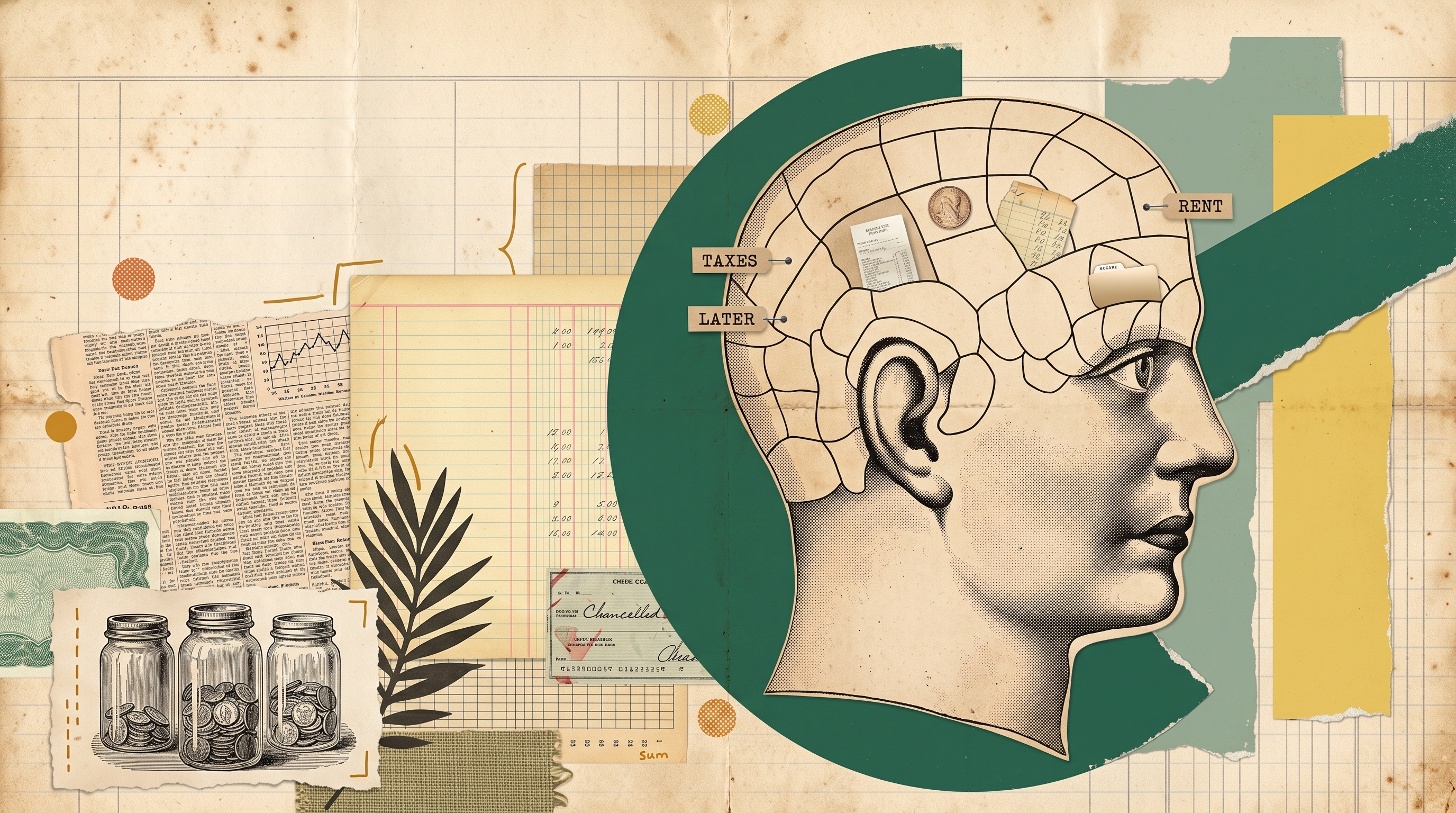
Sound familiar? Don’t feel bad. For many people, it’s hard sticking to the (financial) script when windfall income comes their way. Mental accounting—the way we categorize our money in our own minds—often crosses over into emotional accounting, which has more to do with gut feelings than the bottom line. And that can make budgeting and saving hard.
Luckily, there’s a wealth of research into mental accounting and how it impacts financial decision-making. By drawing on it, you can watch out for common pitfalls. That’s good for your bank account, and good for your private practice.
About the sources
This article mainly draws on Zhang and Sussman’s chapter The Role of Mental Accounting in Household Spending and Investing Decisions in Client Psychology. For more sources—and further reading—check out the list at the end of this article.
What is mental accounting?
Mental accounting is the process of informally categorizing income and expenses for the sake of making financial decisions. Mental accounting is not necessarily a bad thing. It’s something we all do because it simplifies decision-making.
For instance, suppose you’re deciding whether to spend $100 on a new printer for your office. You could consider your total expected lifetime earnings and anticipated expenses, and the opportunity cost you might incur by purchasing the printer rather than something else. You might even depreciate the cost of the printer (plus ink or toner) over its useful life, costing out each print job and determining how much it would pay off in context of your practice’s growth.
But that would be very complicated. Instead, you mentally categorize the printer as an office expense, consider the portion of your assets you have mentally labeled “Money for Office Stuff,” and then make a decision. It’s easier, faster, more convenient, and it makes sense.
That’s fine. Problems only start to arise when you start making logical errors, or when you slip from mental accounting into emotional accounting.
For instance, you might reasonably expect to get 10 years’ use out of a new printer. But instead of considering your budget over the long term, you just look at how much cash you’ve categorized for short-term expenses. Deciding that $100 is too big a chunk of your monthly budget to spend, you put off buying the printer—and the result is a lot of inconvenience later on.
Or else you make an emotional decision. Suppose the cash you’ve categorized for “office stuff” just happens to be the funds you received as a tax refund this year. Studies show that we’re more likely to treat tax refunds as windfalls rather than regular income that’s been deferred. Since you’re dealing with “bonus money,” you decide to splurge on a $500 professional-grade printer. It’s an unnecessary expense, and one that could hurt your finances in the long run.
Recognizing mental accounting for what it is, and learning how to spot logical errors and the roles emotions play, can help you make better decisions for your practice. In particular, the way we categorize income can have a major impact on decision-making.
Mental accounting categories for income
In personal as well as business finances, we tend to categorize income based on its source. And the source of that income helps to determine how we spend it.
That’s an emotional decision, and it violates the law of fungibility—that is, that funds are interchangeable. For instance, the $150 fee you earn from a regular client session is no different from the $150 bonus you earn for opening a business checking account at a new bank. But because of their different sources, you’re likely to spend the money differently. Studies show that when people receive “bonus” money, they’re more likely, when given the choice, to spend it on luxury goods than on other purchases.
Broadly, income fits into two mental categories: Regular income, and irregular income. We typically split irregular income into two further categories: Bonus money and guilty money.
Regular income
You earn regular gross income from the normal day-to-day operations of your therapy practice. It may take the form of:
- Cash pay session fees
- Insurance reimbursements
- Regular consulting or supervision fees
The defining quality of regular income is that it’s recurring and predictable.
For instance, if you have an ongoing consulting contract with the HR department of a local business, you are likely to treat it as regular income. But if you do some one-off consulting for another practice, with no expectation of ongoing work, you’re more likely to treat it as irregular income.
We’re most inclined to spend regular income on business operating expenses and salary payments or owner’s draws. That makes sense: Most operating expenses are recurring. And if you cut yourself a regular paycheck, owner’s draws or salary are recurring as well.
We tend not to spend our regular income extravagantly—after all, we need to keep the bottom line in mind. If anything, we may be excessively conservative with it. An increase in regular income might be funneled into a retirement savings account, for instance, rather than replacing the office printer that’s on its last legs.
Irregular income: Bonus money
When we earn income outside the normal day-to-day work of running our practice, we tend to categorize it as “bonus money.” The usual rules—prioritizing operating expenses and savings—don’t apply.
Income sources in this category include:
- Payment for one-off consulting contracts or speaking fees
- Tax refunds
- Refunds for purchases returned or services cancelled
- Income from occasional or irregular supervision work
- Signup or referral bonuses from banks or credit card carriers
- Legal settlements and insurance payouts
Studies consistently show that the income we categorize as bonus money we are more likely to:
- Spend on unnecessary expenses
- Exclude from our income tracking
- Withdraw as a personal bonus rather than reinvesting in business expenses
This extends beyond personal, mental accounting and into the broader economy. Each year, three out of four Americans receive a tax refund. Many retailers time their sales for when those IRS payouts arrive, even advertising their door-crasher bargains as opportunities to spend refund money.
Even money from regular income streams that arrives outside of its normal schedule may be treated, by recipients, as bonus cash. Employees who are paid biweekly occasionally receive three paychecks per month rather than two. Studies have shown that workers spend more during the months when they receive “extra” paychecks.
Irregular income: Guilty money
The second type of irregular income—and maybe the one that’s most interesting to consider from a psychological perspective—is guilty money.
We’re more likely to spend money we receive as the result of a negative event on expenses we consider essential. The example Zhang and Sussman is of a widow who is more likely to spend a payout from her spouse’s life insurance on school supplies for her child than on other expenses. The working theory is that we spend guilty money on expenses we deem virtuous as a way of diminishing the negative emotions we associate with the funds.
The example of the widow is a drastic one. Others are more common—you may even find them while running your practice. For instance, suppose you charge clients a $50 cancellation fee. A client cancels their appointment at the last minute, without giving a reason, and you charge them the $50. Are you more likely to spend that money on operating expenses, or on a fancy dinner out?
In terms of day-to-day accounting, there’s no reason you wouldn’t deposit the $50 in your business spending account and put it towards something useful. But we’ve already seen that we tend to treat these types of irregular payments as windfalls, so there’s a case to be made for the fancy dinner.
The difference here is that the money comes from a negative event—a client cancelling their appointment, which you may feel reflects poorly on your work as a therapist—rather than a neutral or positive one. So you’re more likely to spend it on something that at least partially removes the guilt you feel receiving it.
Mental accounting for exceptional expenses
How you earn income affects how you categorize it for the sake of mental accounting. That, in turn, affects how you spend it. But what about expenses?
Work by Sussman and Alter has demonstrated that the timing of certain expenses may affect how much we spend on them. That is, if an expense is exceptional, we’re more likely to overspend.
The office printer example from earlier fits well here. Buying a new printer is not something you do often. In fact, compared to regular expenses like rent, utilities, and monthly software subscriptions, it’s highly irregular. You’re more likely to spend extra on an office printer because it’s outside the flow of month-to-month expenses. It belongs to a different mental category.
An exceptional expense doesn’t have to come as a total surprise in order to encourage overspending. Also, you may be further encouraged to buy the latest, top-of-the-line model if you’re drawing on funds you’ve earmarked differently from the ones you use to cover month-to-month expenses—your tax refund, for example.
Other exceptional expenses you may see cropping up in your private practice:
- License renewals
- Annual insurance premiums
- Annual software subscriptions
- Hardware upgrades
- Office furniture or decor
- Security audits
Some of these aren’t especially enticing. It’s unlikely you’ll be swept up in the excitement of renewing your business owner’s insurance package and decide to splurge on, say, alien abduction coverage. Other expenses, like license renewals, are likely to remain fixed.
But because these expenses are exceptional, there’s a greater temptation to leave them out of your budget and assume that, when the time comes, you’ll simply scrape together the cash you need to cover them. That can lead to inaccurate budgets and income shortfalls later on, which is just as bad as if you’d overspent.
Bad mental accounting habits (and how to break them)
Once you recognize how mental accounting affects your business decision-making, and also the role emotions play in how you treat different types of income and expenses, it becomes easier to make clearsighted choices.
Easier, but not necessarily easy. Many of our behaviors when it comes to money are long-established habits, ones that can be hard to shake. Here are a handful of the most common pitfalls to watch out for.
Narrow bracketing
Narrow bracketing is a kind of tunnel vision. It means limiting the scope of a decision to a particular timeframe or event that doesn’t reflect reality.
For instance, each month you may set aside a portion of your income to pay down your student loan. At the end of each month, you look at your bank accounts and decide how much you can afford to spend.
It’s a good idea in principle, but not the most effective method. Studies show that, when households budget annually for expenses like groceries, gas, and utilities, they’re more likely to stay on budget and avoid overspending than if they create a new budget each month.
The solution: broader bracketing.
In this case, broader bracketing—looking at a larger timeframe—can help you make more realistic, well-thought-out choices. An annual budget for paying down your loan will help you stay on track, avoid under- or overspending, and make it easier to plan from one year to the next.
Windfalls and overspending
By now it should be clear that, when we receive unexpected or irregular income, we’re more inclined to overspend it or spend it on luxury items than on normal, everyday expenses.
The solution: reframing windfalls.
The problem is not the windfall itself, it’s the category you assign it.
If you expand your mental category for regular income to include all income—not just what you earn from regular client sessions—you make room for unexpected windfalls. A one-off consulting gig or income from a weekend workshop is no longer extra money you have to spend; it’s just part of your regular business activities.
It’s also important to recognize the true source of some windfalls. Tax refunds are not bonus money you receive from the IRS. They’re funds you’ve already earned as regular income, but overpaid as taxes. The refund balances out a former deficit. With that in mind, splurging on unnecessary expenses becomes less appealing.
Debt aversion
Whether it takes the form of student loans or credit card bills that have gotten out of hand, debt is a problem for many therapists in private practice. There’s no reason to add to your total debt if you don’t have to.
That being said, there’s such a thing as not incurring enough debt. If you never borrow money, you won’t build up a credit rating. Then, one day, when you really need to borrow money—for instance, opening a business line of credit so you can hire clinicians and expand your practice—you’ll find that your options are limited, or that the terms offered by creditors are less than favorable.
This stems from the belief that all debt is bad debt. It’s another type of faulty mental accounting: Putting all debt in one category.
But a business credit card you use to cover recurring expenses—paying it down each month in order to build your credit rating—is not the same as the credit card you had in college that funded your infamous Spring Break adventure (and which you’re still trying to pay off).
The solution: nuanced categories for debt.
Recognizing the difference between short-term debt and long-term debt can help you build your credit usage while keeping debt manageable. So can differentiating between business debt and personal debt (one impacts your practice’s ability to borrow, the other impacts your ability as an individual). When you stop painting all debt with the same brush, it becomes less scary—and you can make credit work for you rather than the other way around.
Failing to budget for or record exceptional expenses
We already know that it can be difficult to account for exceptional expenses. In some cases, you may be tempted to overspend. In others, you leave them completely out of your budget or, when they occur, neglect to record them in the books.
That can result in unexpected shortfalls, budgets that run over, and missed tax deductions. (Any business expense you fail to keep a record of is one you can’t deduct on your tax return.)
The solution: broad bracket budgeting and rainy day savings.
Creating an annual budget—rather than going month-to-month—helps you anticipate expenses that may only come up once a year. And keeping a complete budget—updating your budget with actual figures alongside projected figures, after you’ve earned revenue and incurred expenses—allows you to track your budget’s effectiveness and make changes as needed.
Rainy day savings for unexpected expenses encourage you to track exceptional expenses and avoid overspending. By setting aside predetermined amounts of regular income, you not only build up savings to keep you covered; you ensure the money you spend falls under the “regular income” mental accounting category, making it less tempting to overspend.
Emotional money
Eliminating emotional accounting from your life may be impossible.
Money takes time and effort to earn; shapes how you spend your time each day; and limits or opens up future opportunities for growth, happiness, and freedom. How could it not be emotional?
As a therapist, you put your emotions to work treating clients. And your clients benefit emotionally from your efforts. The essence of your work is emotional, which makes it all the more difficult to disentangle finances from feelings.
But you can take steps to make it less likely that decisions guided by emotions harm your practice materially.
The solution: acknowledge emotional money.
Starting with the mental accounting categories covered above, and recognizing how they affect the choices you make, you can start to analyze the role your emotions play as you grow your private practice.
When new revenue is deposited in your bank account, think about how you’re categorizing it—not in the books, but in your mind. When it’s time to pay the bills, consider how you feel about your expenditures: Are they a burden, or an opportunity to indulge? How do the financial choices you make reflect and impact your self-image as a clinician, as a business owner, and as an individual?
Financial matters are never as clean-cut as they look on paper. There are no numbers you can assign your feelings to guarantee your emotional accounts will be balanced. But by taking a step back and acknowledging your feelings, you can begin to get your books in order.
—
Interested in the points where accounting and psychology intersect? Check out The Cognitive Tax Holding Back Private Practice Therapists and Why Therapists Avoid Checking Their Bank Account (and the Data on What Happens When They Do) .
Sources
Thaler, R. H. (1999). Mental accounting matters. Journal of Behavioral Decision Making, 12(3), 183.
O’Curry, S. (1999). Consumer budgeting and mental accounting. In P. E. Earl & S. Kemp (Eds.), The Elgar companion to consumer research and economic psychology (pp. 280–284). Cheltenham, UK: Edward Elgar.
Levav, J., & McGraw, A. P. (2009). Emotional accounting: How feelings about money influence consumer choice. Journal of Marketing Research, 46(1), 66–80.
Soman, D., & Cheema, A. (2011). Earmarking and partitioning: Increasing saving by low-income households. Journal of Marketing Research, XLVIII, S14–S22.
Sussman, A. B., & Alter, A. L. (2012). The exception is the rule: Underestimating and overspending on exceptional expenses. Journal of Consumer Research, 39, 800–814.
Camerer, C., Babcock, L., Loewenstein, G., & Thaler, R. H. (1997). Labor supply of New York City cabdrivers: One day at a time. The Quarterly Journal of Economics, 112(2), 407–441.
Chan, T., Jiang, Z., & Zhang, D.T. (2017). Bonus induced durable goods consumption and its unintended consequence. Working paper, Olin Business School, Washington University in St. Louis.
Gross, D. B., & Souleles, N. S. (2002). Do liquidity constraints and interest rates matter for consumer behavior? Evidence from credit card data. Quarterly Journal of Economics, 117(1), 149–185.
Hastings, J. S., & Shapiro, J. M. (2013). Fungibility and consumer choice: Evidence from commodity price shocks. The Quarterly Journal of Economics, 128(4), 1449–1498.
Summary
- Mental accounting determines how we sort, label and track money, and includes an emotional component (emotional accounting)
- We sort some earnings into the category of regular income, which we are less likely to spend on unnecessary expenses
- We’re more likely to spend “bonus money” and “guilty money” on luxury items or purchases we see as virtuous, respectively
- Exceptional expenses occur rarely or irregularly, and we tend to avoid budgeting for them or recording them
- Recognizing the role emotions play in financial decision-making and learning about common pitfalls can help us make better decisions
Manage your bookkeeping, taxes, and payroll—all in one place.

Discover more. Get our newsletter.
Get free articles, guides, and tools developed by our experts to help you understand and manage your private practice finances.