Key Takeaways
- You can deduct 50% of the cost of qualifying business meal expenses
- Meals qualify if you share them with colleagues or other work contacts and discuss business
- You can also deduct the cost of meals bought while travelling for business
Many self-employed therapists could reduce their tax bill by deducting business meal expenses, but they don’t.
For those new—and not-so-new—to self employment, the prospect of running afoul of the IRS is just too intimidating. As a result, they’re wary of claiming deductions like the business meals expense.
Here’s what you need to know so you can start to take advantage of the business meals deduction on your next tax return, while avoiding trouble with tax authorities.
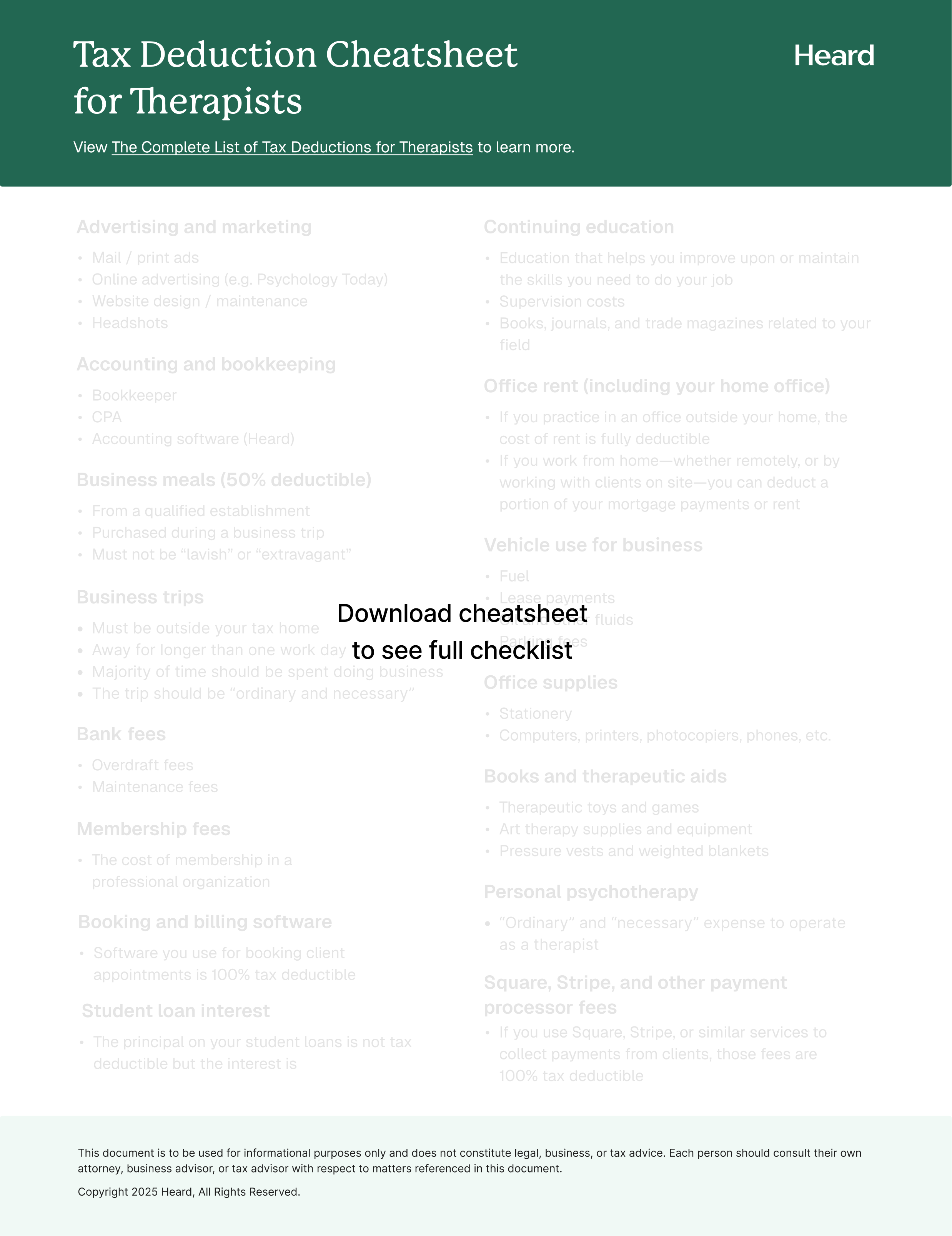
What is a deductible business expense for therapists?
If you’re already familiar with deductible business expenses for therapists, you can skip ahead to the next section on the business meal expense. Otherwise, keep reading for a quick rundown on what deductible expenses are and how they’re typically listed on tax returns.
Ordinary and necessary business expenses
According to the IRS, deductible business expenses are expenses that are both “ordinary and necessary” in the course of conducting a trade or business.
These expenses are typically deductible in the year they are incurred and can include items such as rent, wages, and supplies. In the words of the IRS:
To be deductible, a business expense must be both ordinary and necessary. An ordinary expense is one that is common and accepted in your trade or business. A necessary expense is one that is helpful and appropriate for your trade or business. An expense does not have to be indispensable to be considered necessary.
Deductible business expenses can reduce a business's taxable income, which lowers the amount of taxes owed.
Deductible expenses vs. itemized expenses vs. the standard deduction
A lot of new business owners get mixed up when it comes to personal deductions and business deductions. It’s a common misconception that if you claim the standard deduction on your tax return, you can’t claim business expenses.
Whether you take the standard deduction or you choose to itemize your expenses, it’s reported on Schedule A of Form 1040.
Deductible business expenses, on the other hand, are reported on Schedule C of Form 1040. There is absolutely nothing stopping you from both taking the standard deduction and deducting business expenses. You can learn more from our article on tax deductions for therapists.
{{resource}}
How much is the business meals deduction for therapists?
The amount of the business meals deduction has gone through some changes.
In most years, business meals are 50% deductible.
For the 2021 and 2022 tax years, the IRS made business meals 100% deductible. The increased amount was introduced by the IRS to help offset the rising costs of meals due to inflation.
For the tax year 2023 onwards, business meals are 50% deductible.
There has been one significant recent change: Starting with the 2026 tax year, meals purchased for employees are no longer deductible. (They were formerly 50% deductible.) This is part of the One Big, Beautiful Bill Act (OBBBA).
Business meal deductions for therapists
The Tax Cuts and Jobs Act (TCJA) of 2017 muddied the waters by eliminating the business entertainment deduction. Many small business owners mistakenly took this to mean business meal deductions no longer qualified. That’s false.
So, what is a business meal?
As long as you’re buying a meal for business purposes, it qualifies as a tax deduction. This does not apply to pre-packaged food that you could potentially save to eat later, though.
Here are some examples specific to therapists.
Coffee or meals with business partners or co-workers
So long as you’re meeting to discuss business matters, it’s a deductible business meal.
Example #1: You grab a latte at the cafe down the street and catch up on notes between sessions. It’s not a business expense because you didn’t discuss business matters with other relevant parties. (The fact that you were catching up notes doesn’t justify it as an expense—you could have caught up on your notes without buying a latte.)
Example #2: You and another clinician take a break between sessions to have a coffee. You pay $10 for your drinks. It’s a $5 deduction from your taxes. Conceivably, you could be discussing business matters.
Meals for employees and contractors
If you’re hosting a lunchtime seminar for people who work for you, the cost of the meal qualifies as a tax deduction. The same goes for staff parties or other events where you supply the food.
Example #1: You host a Christmas party for friends and family at your home, and also invite one of the clinicians from your practice. None of the cost of the party is deductible, because it was not hosted primarily for business purposes.
Example #2: You host a Christmas party for your employees. The catering bill comes to $2,000. You can deduct $1,000 from your taxes.
Lunch meetings with potential clients
You’re probably not going to meet a potential one-on-one therapy client for Wing Night at a local sports bar. But if you’re meeting leads—for instance, reps from local organizations considering hiring you to present in-house workshops—it’s a business expense meal.
Example #1: You go out for dinner with friends and the bill is $90. You cannot deduct any of this amount from your taxes, because you did not meet for business purposes.
Example #2: You go out for dinner with the mental health coordinator for a local youth drop-in clinic and the bill comes to $90. You can deduct $45 from your taxes.
While traveling
If you are traveling to a destination away from work for business purposes, meals you purchase en route are tax deductible. Other meals you purchase during the trip are not. You can learn more from our complete guide to business travel deductions for therapists.
Example #1: While travelling to a conference, you purchase a $20 meal in the airport. After arriving at your hotel, you purchase a $50 room service meal. You can only deduct 50% of the $20 meal (for a total of $10) because you purchased it en route, not after you arrived at your destination. The meal you paid for after arriving was for you alone, and did not serve a business purpose.
Example #2: You purchase a $20 meal while travelling to a conference. After arriving at your hotel, you go out for dinner with several other therapists who are attending the conference, and generously foot the $200 bill. You can deduct $110 from your taxes—50% of the meal en route, and 50% of the meal at your destination—because during the dinner with other therapists you discussed business.
Networking
If you purchase food at an event where you could reasonably expect to meet with others in the industry, potentially growing your client list or list of business contacts, you may be able to deduct the cost. In fact, dining in at a restaurant may qualify as “networking.” Check with your accountant before claiming this deduction, however—there are a lot of variables at play.
Example #1: You pay $15 for an appetizer at a local singles mixer. None of the expense is tax deductible. Even though there’s a chance you could meet another therapist at the mixer, the primary purpose is not business networking, so it would be hard to defend as a business expense.
Example #2: You purchase a $25 dinner at a meet-up for local business owners. Even if the other business owners aren’t therapists, there’s a chance you could establish a connection with someone who could send you referrals or help with word-of-mouth marketing. The expense is most likely deductible (a $12.50 tax writeoff).
Are lunches a business expense?
Unfortunately, there really is no such thing as a free lunch.
A meal you purchase only for yourself during work hours—whether it’s lunch, brunch, breakfast, or dinner—does not count as a deductible business expense.
The only exception is if you are travelling for business purposes and you pay for the meal en route, before you arrive at your destination. In that case, you can claim a 50% deduction.
If you share the meal with colleagues, co-workers, employees, potential business leads or partners, and you discuss business matters during the meal, it’s 50% deductible.
{{resource}}
Where do you list business meals deductions on your tax return?
So long as your therapy practice is a pass-through entity—a sole proprietorship, general partnership, S corporation, or an LLC electing any of those statuses—you report business meal expenses on Schedule C of Form 1040.
Keeping receipts and other records for business meals
It’s essential you keep official proof of purchase for any business meals you deduct on your tax return. If the IRS discovers you’ve deducted business expenses on your tax return but you don’t have proof to back those claims up, you could be penalized.
Some best practices:
- Use an expense tracking app. With an app, you can scan or photograph your receipts and keep them on file, safe from damage, indefinitely.
- Make notes for each business meal you deduct. Note the nature of the meeting or event, what was being discussed insofar as it relates to business, and who you met with.
- Keep your receipts for at least six years. The statute of limitations on tax returns is six years. If the IRS believes you’ve committed fraud, they can audit you as far back as six years into the past.
What happens if your business meal deduction is invalid?
If you file a tax deduction but the IRS determines you do not qualify for it, you’ll be penalized.
The penalty amount is 20% of the difference between the amount you actually paid in taxes with an invalid business deduction and the amount you should have paid, plus the full difference itself. That’s 120% total.
Using Form 8275 for protection
Form 8275 is a disclosure statement. You have the option of filing it with your tax return if you believe any of the expenses you’re deducting may be questioned by the IRS.
The purpose of the form is to provide added information backing up your claim. Even if the IRS determines a tax deduction you claimed was not valid, the fact that you filed Form 8275 protects you from paying the penalty—the extra 20% of the difference between what you should have paid and what you did.
More accountants are beginning to recommend clients file Form 8275. The form may be particularly appropriate if you’re claiming a new or unusual deduction.
One example: you’ve never claimed business meal expenses before, but this year you paid for catering for a staff holiday party, so you’re claiming $500. In that case, an accountant may recommend you include Form 8275 when you file your taxes.
It’s especially important to consult with an accountant before filing Form 8275, so you can be sure to avoid any major mistakes.
Summary
- Dining with colleagues and professional contacts, travelling for work, and networking with other therapists can all qualify a meal as a business expense
- Meals or drinks you purchase while working do not qualify unless you share them with someone else and discuss business
- The business expense deduction rate is 50%
- Keep receipts for business meals, and record the date, who you met with, and the topic you discussed (which should be business-related)
- File Form 8275 to provide the IRS with extra information about your meal deductions; even if the deductions are rejected, this form prevents you from being charged a penalty
—
Looking for more ways to lower your tax bill? Check out our complete list of tax deductions for therapists or visit our Therapist Tax Center.
This post is to be used for informational purposes only and does not constitute legal, business, or tax advice. Each person should consult their own attorney, business advisor, or tax advisor with respect to matters referenced in this post.
Bryce Warnes is a West Coast writer specializing in small business finances.
{{cta}}
Manage your bookkeeping, taxes, and payroll—all in one place.

Discover more. Get our newsletter.
Get free articles, guides, and tools developed by our experts to help you understand and manage your private practice finances.