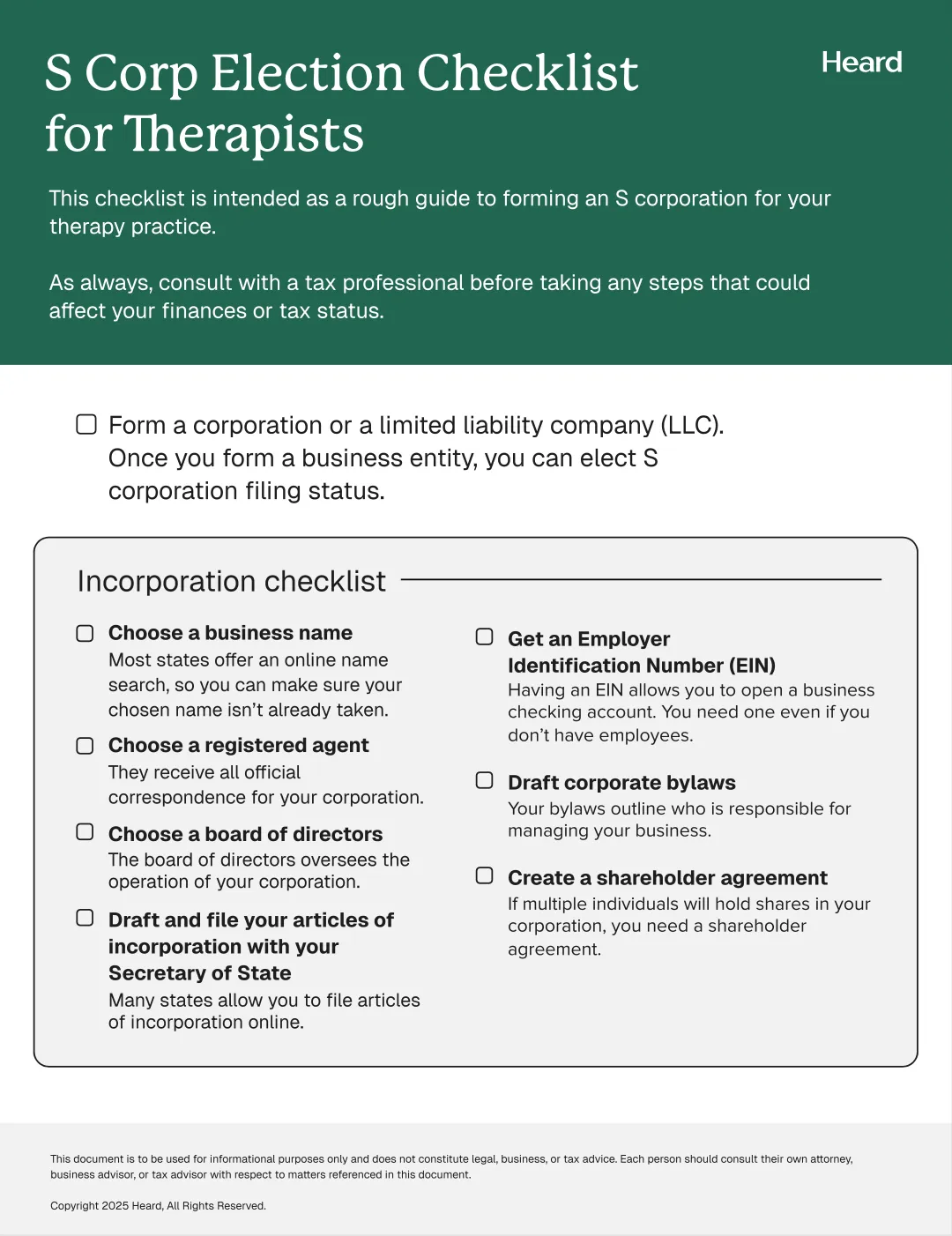

Your private practice is eligible to elect S corporation status once it has registered as a limited liability company (LLC) or professional limited liability company (PLLC).
To do this, you need to file forms with your Secretary of State and pay a fee. The forms and fees required vary by state.
Electing S corp status can earn you tax savings and help you organize your practice’s financial admin to suit your needs. Here’s what you need to know.
When is it a good idea to elect S corp status?
As a rule of thumb, Heard recommends electing S corp status once your practice’s annual income reaches $80,000 – 100,000.
For a sense of where the typical practice sits, the median sole proprietor therapist earned $91,178 in revenue and $66,084 in net income in 2025, according to Heard's income report, below the $100,000 net income mark where S corp savings usually begin to outweigh the added costs.
One major benefit of electing S corp status is tax savings. But it costs more to form and maintain an S corp than a sole proprietorship. Those added costs are only offset by tax savings when you earn about $100,000 net income.
Regardless of income, a professional running their own private practice may elect S corp status when they:
- Want to add shareholders or co-owners to their practice
- Plan to sell or transfer ownership of their practice
- Seek greater liability protection than a sole proprietorship, without the double taxation of a C corporation
Here are some Heard resources to help you make your decision. They’re written for self-employed therapists, but the information applies to all private practice owners:
- The Complete Guide to S Corporations for Therapists
- How to Pay Yourself as a Therapist
- Tax Basics for S Corporation Therapists
Can a sole proprietor elect S corp status?
A sole proprietor cannot elect S corp status. Only a registered legal entity—an LLC or a PLLC—can file Form 2553 to elect S corp status.
How do I register my private practice as an LLC?
As a general guide, the steps to follow are:
- Determine whether your state requires you to form an LLC or a PLLC
- Register a doing business as (DBA) name (if you haven’t already)
- Get an employer identification number (EIN)
- Choose or hire a registered agent
- File Articles of Organization with your Secretary of State
- Pay the required fees
- Wait for a letter from your Secretary of State confirming the registration of your LLC or PLLC.
The precise process for registering your private practice as an LLC or PLLC varies by state. So do the fees you need to pay. For a step-by-step guide, plus links to resources for your state and a complete table of fees, check out The Complete Guide to LLCs and PLLCs for Therapists.
{{resource}}
How does my private practice LLC elect S corp status?
To elect S corporation status with the IRS, your LLC or PLLC must file Form 2553.
What information do you include on Form 2553?
On Form 2553, you must provide general business information:
- The legal name of your LLC
- Your EIN
- Your business address
- The date of your LLC formation
- The state where your LLC is registered
- The tax year the S corp election will take effect
- The effective date of your S corp election
- Your reason for filing (eg. new LLC, late election, entity classification change)
- Relief for late election (if filing late, provide representations that you meet eligibility requirements)
You’ll also need to provide information about your registered agent. Your registered agent acts as a point of contact for all official matters regarding your LLC. Include:
- Their name and title
- Their phone number
- Their signature and the date
Finally, you must provide information on each shareholder. If you are the sole owner of the LLC, you only need to provide your own information, including:
- Name
- Address
- Social security number (SSN) or EIN
- Ownership percentage
- The number of shares owner
- The date the shares were acquired
- The shareholder’s tax year (fiscal or calendar)
- Signature and date (consenting to act as a shareholder)
When is the deadline to elect S corp status with Form 2553?
The deadline to file Form 2553 and elect S corp status is two months and fifteen days after the start of the tax year you want the election to take effect. If the deadline falls on a holiday or weekend, it moves to the next weekday.
So, to have your business treated as an S corp for tax purposes for the 2027 tax year, the deadline to elect S corp status is March 15, 2027.
You can also file Form 2553 at any point during the year before the election takes effect. So you could file it at any time in 2026 to elect S corp status for the 2027 tax year.
—
Provided you meet the $100,000 income threshold, S corp status comes with significant tax benefits. Learn more from How to Maximize S Corp Status.
This post is to be used for informational purposes only and does not constitute legal, business, or tax advice. Each person should consult their own attorney, business advisor, or tax advisor with respect to matters referenced in this post.
Bryce Warnes is a West Coast writer specializing in small business finances.
{{cta}}
Manage your bookkeeping, taxes, and payroll—all in one place.

Discover more. Get our newsletter.
Get free articles, guides, and tools developed by our experts to help you understand and manage your private practice finances.