
As a private practice therapist, it may feel like your finances are looming over your head.
Will you manage to file your taxes accurately? Where will you find the time amidst a full caseload of clients? And, perhaps the most stressful question, how much will you owe the IRS?
Fortunately, along with private practice taxes comes the art of tax deductions and write offs.
Though it may sound emotionally and financially daunting at first, getting a firm grasp on tax deductions can be quite advantageous and save you hundreds or thousands of dollars for your business.
Key takeaways
- A therapy practice expense is deductible when it is for business use and “ordinary and necessary” in the field, per Section 162 of the tax code.
- The highest-value deductions for most therapists are office rent or home office, software and EHR subscriptions, continuing education, licenses and memberships, and business mileage.
- The IRS standard mileage rate for 2026 is 72.5 cents per business mile. Your regular commute does not count.
- Business meals are generally 50% deductible when there is a work purpose, like meeting a supervisor or referral partner.
- Home office costs are deducted in proportion to the space used exclusively for your practice, or through the simplified method of $5 per square foot up to 300 square feet.
- Purchases of $2,500 or more, like office furniture or a computer, are typically depreciated. Under current law, 100% bonus depreciation lets you deduct most of them in full the year you buy them.
- Personal therapy is a gray area. Some accountants treat it as a business expense for clinicians, others as a medical expense. Ask yours how they handle it.
- Keeping business and personal finances in separate accounts is the single habit that makes every deduction easier to claim and defend.
{{resource}}
What are tax deductions?
Not every business expense is tax deductible.
In order to write off an expense of your therapy practice on your tax return, Section 162 of the U.S. tax code requires the expense be:
- For business use
- “Ordinary and necessary,” defined as commonly accepted in your industry and helpful & appropriate for your trade or business, respectively
When you complete your tax return and include deductible expenses, you’re saying to the IRS, “I earned X in revenue this year, but spent Y in expenses.”
You’ll pay taxes on an amount you reach by subtracting Y from X.
Most valuable tax deductions for therapists
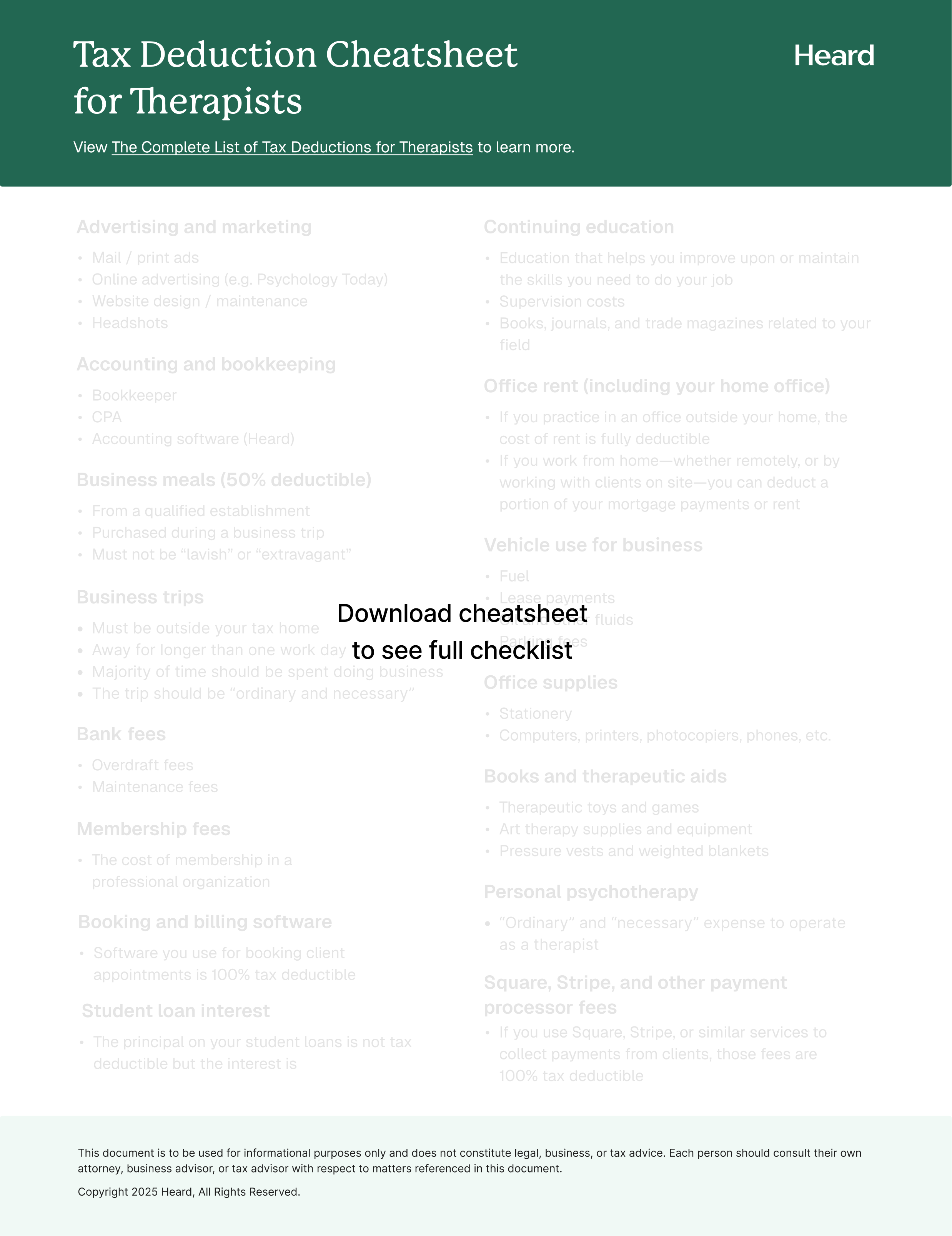
Here are some common tax deductions to be aware of, especially for those just starting out in private practice:
Advertising and marketing
Any costs associated with marketing your business. For therapists, a lot of the time this can look like the costs for your website: domain hosting, web design, graphic design.
Advertising costs can also include money you spend on tangible products, such as print advertisements or business cards.
Business meals
When you purchase a meal for business-related purposes, you can write it off as a tax deduction.
Typically, this would be for a work reason, such as a meeting with a co-worker or a consultant, or a lunch with a client. Business meals are generally 50% deductible, so keep the receipt and jot down who you met with and why.
Bank fees
Pesky bank fees can definitely add up when you are running your own business and operating separate bank accounts for your business checking and savings.
Account fees, interest, and credit card processing fees can all be tax deductible.
Vehicle use for business
Granted you are using your car for business-related use outside of your regular commute, your mileage may be deductible, along with general upkeep expenses on your car.
To use this deduction, you will need to keep close track of how many miles you are driving per year that specifically pertain to business use. These miles must be out of the standard commute between your home and work, if you are a commuter.
You can use two specific methods here to calculate what from your vehicle use is tax deductible:
- Standard mileage rate: First, multiply the amount of miles you’ve driven for business purposes only by the IRS’ standard mileage rate. For 2026, the IRS standard mileage rate is 72.5 cents per mile, up from 70 cents in 2025. Note: the mileage rate adjusts every year in order to keep up with inflation.
- Actual expense: You’ll first need to determine the actual full cost to operate your vehicle, including license, registration, gas, oil, and upkeep. You’ll then multiply this cost by the percentage of miles driven for business use on your car.
Membership fees
If you belong to any professional organizations, such as the APA, these expenses can also be deductible.
Continuing education
Many therapists choose to continue their education, attending courses, workshops and conferences to further improve their skills and learn how to run their own businesses.
As long as these endeavors apply to your practice, the costs can be written off.
Office expenses and supplies
This one adds up faster than most therapists expect, especially if you work from home and have built out your own desk setup and supplies.
These can include pens, scissors, staplers, printer ink, postage, small furniture pieces and cleaning supplies––along with anything that helps you stay organized as a therapist.
Software services
Any practice management software, such as TherapyNotes or SimplePractice, is deductible within this category, as it helps you to run your business smoothly and efficiently.
Additionally, any other software you use to run your business, along with business software such as Google Drive, Apple storage, or Heard, can also be written off.
Office rent and utilities
If you run your private practice from an office, your rent and utilities (such as a phone or electric bill) can often be written off.
If you’re working out of your home or sharing utilities for business and personal use, this can get tricky as you’ll only be able to deduct your percentage of business usage. The space has to be used regularly and exclusively for your practice. You can deduct that percentage of rent or mortgage interest, utilities, insurance, and repairs, or use the IRS simplified method of $5 per square foot for up to 300 square feet. Our home office deduction calculator does the math for you.
Business registration and license fees
This is particularly important if you’re new to private practice this year; you’ll be able to write off a lot of the startup business costs.
Renewal of your license can also be written off.
Travel expenses
Deductions from travel can add up quickly. This includes anything used for business purposes, and generally requires that you travel away from the area where your practice is based and stay overnight.
Costs eligible for deduction include mileage, meals and parking.
Personal psychotherapy
Are you seeing your own therapist? Some tax professionals treat personal therapy as a business expense for clinicians, especially when it functions as supervision or consultation that supports your work. Others treat it as a personal medical expense, which only counts on Schedule A once your total medical costs pass 7.5% of your adjusted gross income.
Accountants differ on this one, so ask your tax professional how they classify it before you claim it.
Depreciation expenses
This write off can often be one of the more difficult ones to understand, but essentially it entails any larger purchases over $2,500. For therapists, a common write-off in this category is office furniture.
You can choose to deduct these purchases in full the year you place them in service, or in increments over the years the item is used. Under current law, 100% bonus depreciation is permanent for property acquired after January 19, 2025, so most therapists can take the full deduction right away. Anything under $2,500 can usually be expensed immediately under the IRS de minimis safe harbor.
{{resource}}
Maximizing tax deductions for your practice
The list goes on, with additional write-offs available for costs such as insurance, legal or professional fees, moving expenses, and salary and benefits for any private practice owners who have employees.
Tax deductions can definitely come in handy, and the key to maximize them (and your sanity) is to keep all your business finances separate from your personal expenses and well-organized.
This way, when the end of the year rolls around, you’ll have all of your business expenses in one place.
While the above list is a general overview of some helpful write offs, it’s important to remember that your deductions can vary based on your business entity and personal situation.
Frequently asked questions about tax write-offs for therapists
What tax deductions can a therapist in private practice claim?
Therapists in private practice can deduct ordinary and necessary business expenses, including office rent, home office costs, EHR and practice management software, continuing education, licensing and board fees, professional association dues, liability insurance, marketing, business mileage, bank and payment processing fees, and depreciation on equipment and furniture. Each expense must be used for the practice and be typical for the profession.
How much is the mileage deduction for therapists in 2026?
The IRS standard mileage rate for 2026 is 72.5 cents per business mile, up from 70 cents in 2025. Driving between offices, to a client's home, or to a training qualifies. Your regular commute from home to your main office does not. You can use the standard rate or track actual vehicle expenses, whichever gives the larger deduction.
Can therapists deduct their own therapy?
Sometimes. Some tax professionals treat personal therapy as a business expense for clinicians because it supports your ability to do the work, especially when it functions as supervision or consultation. Others treat it as a personal medical expense, which is only deductible on Schedule A if your total medical costs exceed 7.5% of your adjusted gross income. Ask your accountant how they classify it before you claim it.
Can I write off my home office as a therapist?
Yes, if you use part of your home regularly and exclusively for your practice. You can deduct the business-use percentage of rent or mortgage interest, utilities, insurance, and repairs, or use the simplified method of $5 per square foot for up to 300 square feet ($1,500 max). A room that doubles as a guest bedroom does not qualify.
Are business meals 100% deductible for therapists?
Business meals are generally 50% deductible. That includes coffee with a referral partner, lunch with a supervisor, or a meal while traveling for a conference. Meals for your own convenience during a normal workday are personal expenses and cannot be deducted.
Is continuing education tax deductible for therapists?
Yes. CE courses, workshops, conferences, books, and training that maintain or improve skills in your current profession are deductible, along with related travel. Education that qualifies you for a new profession, like a degree program to become a psychiatrist, is treated differently and usually is not deductible as a business expense.
Can I deduct my therapy license and professional memberships?
Yes. State licensing fees, board certification and renewal fees, and dues to organizations like the APA, ACA, or NASW are deductible business expenses. Business registration fees for your LLC or S corp also qualify.
What is depreciation and when does a therapist need it?
Depreciation spreads the cost of a larger purchase across the years you use it. The IRS de minimis safe harbor lets you expense items under $2,500 right away. For items at or above that amount, such as office furniture or a laptop, 100% bonus depreciation currently allows you to deduct the full cost in the year you place it in service, or you can depreciate it over several years.
How do I keep track of write-offs so I don't miss any?
Open a separate business checking account and business credit card, run every practice expense through them, and reconcile monthly. Save receipts for anything over $75 and keep a mileage log with dates, destinations, and purpose. Bookkeeping software or a service built for therapists, like Heard, can categorize expenses as they happen so nothing is missed at tax time.
Do I still get deductions if I take the standard deduction?
Yes. Business expenses are deducted on Schedule C (or your S corp return) before your income reaches your personal return. The standard deduction applies to personal income and does not affect your ability to write off practice expenses.
Want to claim more tax deductions? Check out our complete list of tax deductions for therapists.
Visit our Therapist Tax Center and Tax Deductions for Therapists Hub for everything you need to know about taxes as a practice owner. If you're just starting out, here's everything you need to know about How to Start a Private Practice as a Therapist.
At Heard, we recommend working directly with a tax professional to file your taxes, and offer free, 15-minute consultations to help make tax season easier and improve the financial health of your private practice.
This post is to be used for informational purposes only and does not constitute legal, business, or tax advice. Each person should consult their own attorney, business advisor, or tax advisor with respect to matters referenced in this post.
{{cta}}
Manage your bookkeeping, taxes, and payroll—all in one place.

Discover more. Get our newsletter.
Get free articles, guides, and tools developed by our experts to help you understand and manage your private practice finances.